
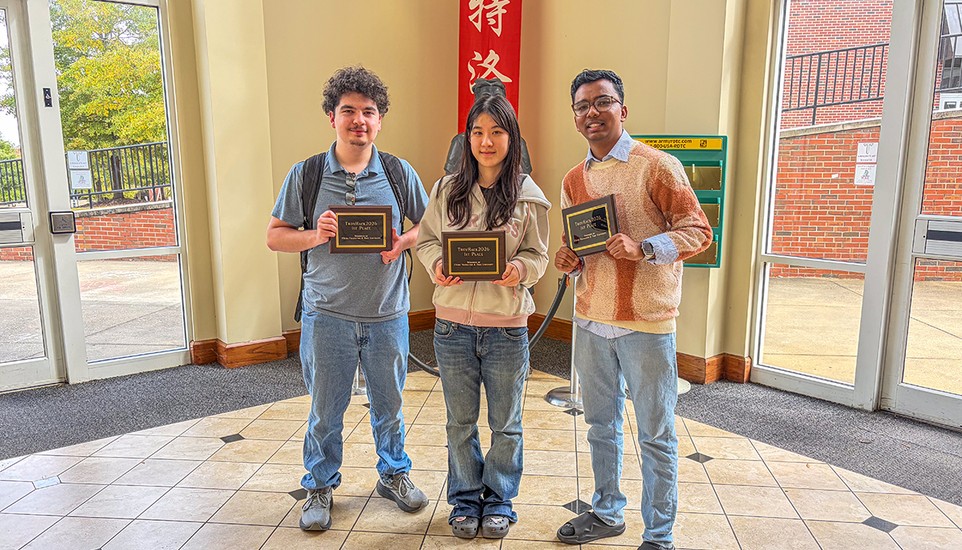
Troy University announced the winners of its hackathon on November 13, 2026, with a first-place team developing an innovative AI-powered Chrome extension designed to identify potential phishing threats. The winning team consisted of Hadiyel Nileshkumar, Jackson Rodriguez, and Soeun Kim, who stood out among competing student developers for their technology-focused solution.
The hackathon showcased student innovation and industry collaboration, bringing together student programmers to tackle real-world technology challenges. Nileshkumar, Rodriguez, and Kim's project demonstrates the growing intersection of artificial intelligence and cybersecurity, addressing the critical need for accessible tools to combat phishing attacks—a persistent threat to individual and organizational security.
Second place was awarded to a team comprising Joey Hudson, Daniel Mensah, Xiameng "Chloe" Zhang, and Charles Wood, while third place went to Cullen Lovvorn, Atticus Cornett, and Ethan Burnham. The diversity of team sizes and compositions reflected the collaborative nature of the hackathon format, allowing students to work in groups of varying sizes to develop their solutions.
The event at Troy University underscored the institution's commitment to fostering innovation among its student body and creating opportunities for hands-on experience with cutting-edge technology development. By hosting hackathons that emphasize industry collaboration, Troy University provides students with practical experience in a competitive environment while addressing real technological challenges.
The winning AI-powered Chrome extension project represents the type of practical, user-focused solution that emerges from hackathon competitions, where time constraints and collaborative pressure often yield creative approaches to complex problems. The phishing detection tool created by the first-place team has immediate applications for everyday internet users seeking enhanced security protections.